Queen Anne’s diamond studs
The Three MusketeersQueen Anne’s diamond studs are the twelve jewels at the center of the novel’s most compressed chain of love, espionage, and political danger. Given by Queen Anne to the Duke of Buckingham in a rosewood casket bearing her cipher, they become evidence of a forbidden intimacy, the bait in Cardinal Richelieu’s scheme, the object of d'Artagnan’s hazardous journey, and finally a set of jewels whose exact imitation allows the queen to survive a public test. Their importance lies not in their size but in the obligations and suspicions attached to their passage from hand to hand.
Origin as a Private Gift
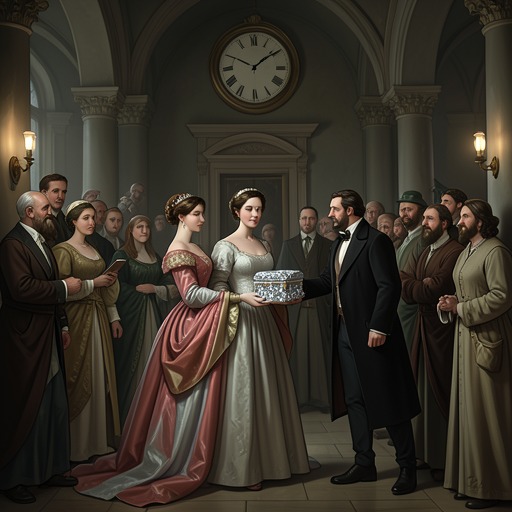
Queen Anne’s diamond studs first appear as a pledge demanded by Buckingham. He asks Queen Anne for something she has worn, an object that can prove his visit was real and preserve its memory after he departs. In response, the queen returns almost immediately with a rosewood casket bearing her cipher in gold. She gives it to Buckingham as a remembrance, and he receives it on his knees. The casket therefore establishes the studs as more than royal property: they are enclosed within a token of personal attachment, and the physical object carries the emotional force of the meeting even when the lovers must separate.
The casket’s secrecy is soon exposed through court testimony. Donna Estafania is remembered as having returned only to take the little rosewood box, then leaving again without it. Madame de Lannoy knows what it contained: the diamond studs Louis XIII had given Queen Anne. This distinction between the royal gift’s original source and its later destination makes the jewels politically explosive. They belong to the queen as part of her royal adornment, yet their removal places them in Buckingham’s possession and links them to a private exchange that the court cannot safely acknowledge.
Richelieu’s Trap
Cardinal Richelieu turns the jewels into an instrument of surveillance and accusation. He repeatedly directs Louis XIII’s attention to them, first presenting a ball as an occasion for Queen Anne to wear the beautiful diamonds given to her on her birthday, and later advising the king to tell her, on the evening before the fete, that he wishes to see how the studs become her. The apparent social invitation is thus designed as a test. If the queen appears without them, her absence of the jewels can be read as proof that they have been given away; if she wears them, the cardinal’s intended accusation collapses.
The timing makes the trap especially severe. The city fete is fixed for October 3, while Richelieu’s reminder is meant to be delivered the previous evening. The queen is not merely asked to dress for a celebration: she is placed under a deadline by a monarch whose suspicion has been carefully stimulated. The studs become a concealed political weapon. Richelieu does not need to name the affair openly; he only needs to make their absence visible before the court.
The London Mission
Mme. Bonacieux recognizes the danger and tells Queen Anne that the studs were given to Buckingham and placed in the little rosewood box he carried under his arm. Her immediate conclusion is that they must be recovered. The jewels therefore convert knowledge into action: once their location is understood, a mission must cross the channel before the royal ball exposes the queen.
Richelieu simultaneously sends an order to Milady the English spy. His letter commands her to attend the first ball at which Buckingham appears, observe the twelve diamond studs on his doublet, approach him, and cut off two. She is then to report as soon as the two pieces are in her possession. The plan reveals the cardinal’s preference for indirect evidence. Rather than seize the entire casket or openly accuse the queen, he seeks to remove two identifiable jewels and make the queen’s failure to display the complete set undeniable.
The jewels also define the stakes of d'Artagnan’s journey to London. His task is not a symbolic errand but a race against the court’s appointed date and against Richelieu’s agent. Buckingham places d'Artagnan in a chamber adjoining his own, keeping him close partly because he wants someone with whom he can continually speak about the queen. In this setting the studs are surrounded by both military urgency and emotional recollection: the duke guards the objects that embody his attachment while depending on a young messenger to restore them to their royal owner.
Substitution and Public Proof
The English closure of the ports makes the mission more dangerous. An ordinance forbids every vessel bound for France to leave London, including the packet boat carrying letters; to public opinion, this amounts to a declaration of war between the two kingdoms. Against that political blockade, Buckingham has two missing studs reproduced. By the day after the morrow, the imitations are so exact that he cannot distinguish them from the originals, and experts would have been deceived as well.
Buckingham gives the reconstructed pair to d'Artagnan and insists that he has done everything human power could do. He keeps the rosewood casket, explaining that it would encumber the messenger and that, as the only thing left to him, it is the more precious. This division is revealing: the studs can be returned because they perform a public function, while the casket remains as the intimate residue of the encounter. The jewels are restored as evidence; the container remains as memory.
When d'Artagnan explains that the diamond does not come from an enemy but from the queen, M. de Treville immediately understands its value and identifies it as a genuine royal jewel worth a thousand pistoles. D'Artagnan states that Queen Anne gave it to him herself. The jewel consequently authenticates his mission and his access to the queen’s confidence, even as its value makes the possession of it perilous.
Circulation, Value, and Narrative Meaning
The studs move through several systems at once. They begin as a birthday gift from Louis XIII to Queen Anne, become a private pledge from the queen to Buckingham, are targeted by Richelieu as incriminating evidence, are recovered through d'Artagnan’s mission, and return to the queen’s public sphere in imitation form. Their material identity is unstable, but their social meaning remains powerful. What matters is not only whether a jewel is original; it is who can recognize it, who can claim to have seen it, and what absence or presence makes possible before witnesses.
Their economic value also sharpens the novel’s contrast between royal magnificence and practical desperation. The king rewards d'Artagnan with forty pistoles for the service of the crown, while the studs represent a much greater concentrated fortune. Elsewhere, Athos and d'Artagnan obtain three hundred pistoles by pledging Athos’s sapphire ring, although a jeweler offers five hundred if he may buy it as a pendant for earrings. That comparison places the royal studs within a wider world in which jewels finance military equipment, preserve honor, and generate urgent obligations. Yet unlike the sapphire, which can be pledged for cash, the queen’s diamonds cannot safely be treated as ordinary property: their political meaning exceeds their price.
The studs also foreshadow the novel’s recurring treatment of gifts as dangerous bonds. A royal jewel creates gratitude, suspicion, and a demand for return; a rosewood casket preserves intimacy but also preserves proof; and the cardinal’s later carte blanche reverses the direction of obligation by granting d'Artagnan a lieutenant’s commission. Across these exchanges, objects do not remain passive possessions. They recruit messengers, expose relationships, authorize punishment, and transform private loyalty into public action. Queen Anne’s diamond studs are therefore the most visible embodiment of the novel’s governing tension: affection must travel through objects, but once an object enters the political world, affection itself becomes evidence.